Solar Rechargeable Standing Fan 16 Inch | OEM & Wholesale from China
Source 16-inch solar rechargeable standing fans from China OEMs. 12,000 mAh battery, 9V 12W solar panel, USB output. Mechanical and remote models.
 Reviewed by Martin Wang , Founder & Sourcing Engineer
 Published
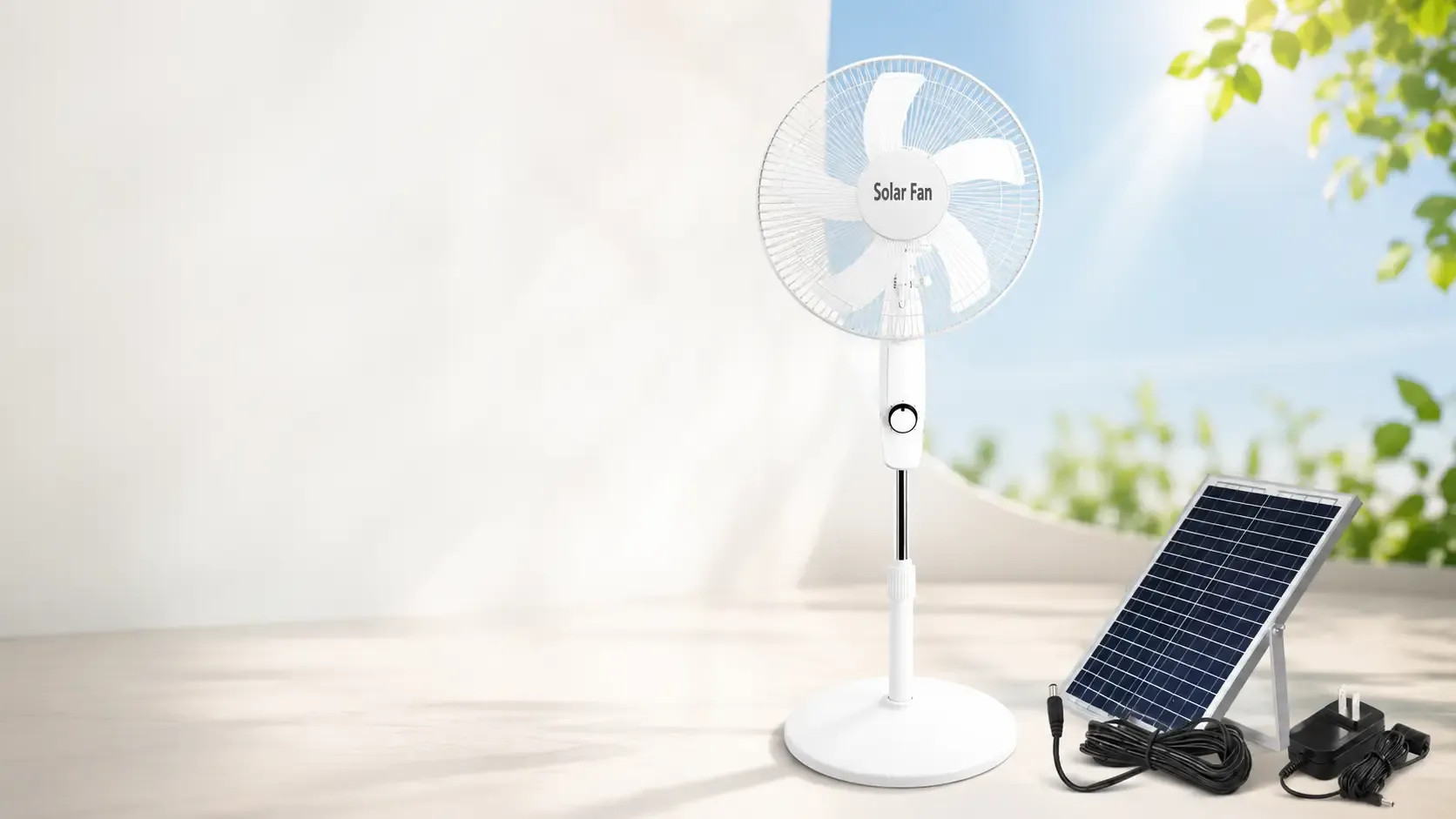
What a Solar Rechargeable Standing Fan Is
A solar rechargeable standing fan is a DC-powered pedestal fan that can run from a lithium battery, a small solar panel, or an AC wall adapter. For markets with unreliable grid power, outdoor events, off-grid cabins, and emergency-preparedness buyers, it is a practical cooling appliance that does not depend on mains electricity. The 16-inch floor-standing format is the most common retail size: large enough to move meaningful air in a room, yet compact enough to ship in a single carton by sea or air.
The units described here use a 555-series DC motor drawing about 15 W, a 12,000 mAh ternary lithium battery pack, a 9 V 12 W solar panel, and a 9 V 2 A DC charger. The battery and charge-control side of the product sits squarely in power electronics sourcing territory, which is where most of the quality risk lives. They are produced as OEM/ODM catalog models by small-appliance factories in Guangdong and Zhejiang, with four variants: mechanical 3-speed (MF-58, MF-51), remote 4-speed (MF-59), and remote with mosquito lamp / sleep mode (MF-60).
Why the 16-Inch Format Works for Private Label
The 16-inch / 430 mm guard diameter is a market sweet spot. Smaller 12-inch desk fans do not move enough air for a room; larger 18-inch industrial fans cost more to ship and require heavier motors. A 16-inch standing fan with a 1.4 m height fits the household-positioning slot that buyers on Amazon, African distributors, and Southeast Asian retailers all target.
The four model tiers give you clear price-segmentation options without redesigning tooling:
- MF-58 mechanical: the entry point. Three speeds, LED light, USB phone charging. Best for price-sensitive bulk markets.
- MF-51 mechanical: functionally identical to MF-58, differentiated by color SKUs (white/gold, white/blue, all black, black/grey). Useful if you want to test color preference before committing to a private mold.
- MF-59 remote: adds remote control, charging indicator, and 4-speed settings. Justifies a $4–6 retail premium over mechanical versions.
- MF-60 remote: adds mosquito lamp and sleep mode for the outdoor/camping and tropical-market positioning. Highest ASP and strongest review differentiation.
Battery and Solar System: What the Specs Mean
The 12,000 mAh battery is usually assembled from 3.7 V cylindrical cells in a 3S2P or similar configuration, giving roughly 44.4 Wh of stored energy. That is enough for a few hours of fan runtime, but the real-world performance depends heavily on how honest the factory is about three things.
Actual cell capacity. Ternary lithium (NCM or NCA) cells are lighter and more energy-dense than lithium iron phosphate (LiFePO₄), but they also have stricter shipping requirements and shorter cycle life. Ask for the cell brand and datasheet. Generic B-grade cells often deliver 70–80% of rated capacity after 100 cycles. A reputable factory will use A-grade 18650 or 21700 cells from a recognizable supplier.
Battery management system (BMS). A 3S lithium pack needs overcharge, over-discharge, over-current, and short-circuit protection. The BMS also balances the cells during charging. Request the BMS schematic or at minimum the protection IC part number. Fires in rechargeable fans almost always trace back to a missing or undersized protection circuit.
Solar panel real output. The 9 V 12 W rating is the panel’s peak output under ideal laboratory conditions. In real use, expect 6–9 W in strong sunlight. More importantly, many low-cost suppliers ship panels that test at 6–8 W but are labeled 12 W. Require a load test at 1,000 W/m² irradiance showing voltage and current into a matched resistor. The panel should deliver at least 1.0 A at 9 V.
Charging path. These fans charge through a DC barrel input (9 V 2 A) and can trickle-charge from solar simultaneously. Ask whether the charge controller supports both inputs at once without back-drawing current from the battery when the sun drops. A proper controller uses a simple diode OR-ing circuit or a small MPPT board; cheaper designs can drain the battery overnight through the panel.
Motor, Blades, and Airflow
The 555 DC motor is a standard brushed DC motor used in millions of small appliances. At 15 W it is adequate for a 16-inch residential fan. The key quality variable is not the motor model number but the bearing and winding spec.
Sleeve vs. ball bearings. Sleeve bearings cost $0.30–0.50 less per motor but wear out after 1,000–2,000 hours, especially in dusty environments. Ball-bearing motors last 5,000–8,000 hours and are worth specifying for any private-label brand. Ask the factory to confirm the bearing type in writing.
Blade balance. Five PP plastic blades are common, but injection-mold tolerances cause vibration and noise if the blades are not balanced. A good factory will run a blade balance test and trim the blade weights before assembly. Request a sample and listen for wobble at the highest speed.
Noise level. There is no universal spec here, but a well-built 16-inch DC standing fan should run below 55 dB at medium speed. If the factory cannot provide a noise test report, plan to measure the sample yourself in a quiet room.
Certifications and Compliance by Market
EU/UK:
- CE (LVD + EMC) — mandatory for any electrical appliance sold in the EU.
- RoHS — restricts lead, cadmium, mercury, and other hazardous substances in the PCB and wiring.
- REACH — required for plastic and coating materials, especially colored ABS housings.
- UKCA — the UK post-Brexit mark; testing is largely equivalent to CE.
United States:
- The fan itself, running on low-voltage DC from a battery, does not require UL. However, the bundled 9 V 2 A AC charger does if you want mainstream retail placement. Look for a UL-listed or ETL-listed adapter.
- If the model has a remote control or any digital circuit, FCC Part 15B emissions testing is expected by most retailers.
- California Proposition 65 warnings may be needed for PVC cables and certain plastics.
Shipping:
- UN38.3 testing is mandatory for air freight of lithium batteries and strongly recommended for sea freight to satisfy carriers and customs. Ask for the UN38.3 test summary and the battery MSDS before booking logistics.
Packaging, Carton Size, and FBA Considerations
The single-unit carton for mechanical and MF-59 models measures roughly 44.5 × 15.5 × 56 cm. The MF-60 remote variant with extra features ships in a slightly different carton at 49 × 22.5 × 43.5 cm. At 4.5–5.0 kg per unit, a master carton of two units will weigh roughly 10–11 kg, which is manageable for parcel carriers and LCL sea freight.
For Amazon FBA sellers, confirm the outer carton dimensions against the current size-tier thresholds before finalizing packaging. A 1 cm reduction in one dimension can sometimes drop the unit into a lower fulfillment-fee band. Also plan for the solar panel: it is usually packed in the same carton but may require additional foam protection on the glass surface. ISTA 1A or 2A drop testing from 76 cm is a sensible minimum for a product with a glass-fronted solar panel.
Common Failure Modes to Catch at Sample Stage
Battery runtime exaggeration. Factories often quote runtime at the lowest speed with the LED off. Test the sample at each speed setting and with the light on to get real numbers.
Solar panel under-delivery. Measure open-circuit voltage and short-circuit current in direct sunlight. A 9 V 12 W panel should read roughly 10–11 V open circuit and 1.3–1.5 A short circuit.
Wobbly oscillation mechanism. The oscillation gear in low-cost fans can strip or grind after a few weeks. Run the oscillation function continuously for 24 hours on the sample and listen for clicking or binding.
Weak DC barrel jack. The charging port is a high-cycle connector. A loose jack causes intermittent charging and returns. Inspect the jack mounting and strain relief on the sample.
LED light flicker. Cheap LED drivers produce visible flicker that consumers notice on camera. A simple phone slow-motion video test will reveal it.
Pricing and First-Order Economics at 500 Units
| Item | Cost estimate |
|---|---|
| MF-58 / MF-51 mechanical, ex-works | $22–28/unit |
| MF-59 remote, ex-works | $28–33/unit |
| MF-60 remote + mosquito lamp, ex-works | $32–38/unit |
| Color box + manual | $1.00–1.50/unit |
| CE / RoHS testing (one-time) | $1,500–2,500 |
| UN38.3 battery test | $800–1,500 |
| Sea freight Shenzhen → Los Angeles (500 units) | ~$1,200–1,800 |
Margins are strongest in markets where grid power is expensive or unreliable, because the solar story justifies a higher retail price than a basic AC fan. Distributors in Nigeria, Kenya, the Philippines, and parts of Southeast Asia often sell comparable units at 2.5–3.5× FOB. Buyers building an off-grid product line frequently pair this fan with a solar water heater from the same factory cluster.
Sourcing notes from the floor
We typically audit fan factories in Zhongshan and Foshan for battery cell brand verification and solar-panel load testing. During the factory visit last month, our client saw B-grade ternary cells deliver only 70–80% of rated capacity after 100 cycles, and 6–8 W panels sold as 12 W. The most common spec mismatch is accepting runtime claims at the lowest speed with the LED off instead of testing each speed setting. Real-world MOQ is 500 units, and remote-control variants run $4–6 more than mechanical. Certification gotcha to watch: the bundled AC charger needs UL/ETL listing for US retail, even though the low-voltage fan itself does not.
Recommended Next Steps
Before sampling, lock the motor bearing type, battery cell brand and BMS spec, solar panel real-output test method, and certification scope. Run a 24-hour oscillation test and a full battery-discharge test at each speed. Compare quotes from at least two factories in Zhongshan/Foshan (strong on small appliances) and one in Ningbo/Yongkang (often lower mechanical cost). When you have a shortlist, use our factory audit checklist and book a quality inspection before shipment. For help with supplier shortlisting and RFQ management, start with our sourcing service.
Common questions
What is the realistic FOB price for a 16-inch solar rechargeable standing fan from China? +
Mechanical 3-speed models typically land at $22–28/unit FOB Shenzhen at 500 units. Remote-control 4-speed versions with extra lighting or mosquito-lamp functions run $28–38/unit. The 9 V 12 W solar panel and 12,000 mAh ternary lithium battery are the two largest cost drivers.
Which certifications are required for solar rechargeable fans in the EU and US? +
EU/UK: CE (LVD + EMC), RoHS, REACH. UKCA for the UK. US: there is no mandatory federal certification for a low-voltage DC fan, but most retailers expect FCC Part 15B if the unit has a remote control or charging circuit, plus UL/ETL for the AC charger adapter if bundled. Battery UN38.3 testing is required for air freight and strongly recommended for sea freight documentation.
How long does the battery actually run the fan? +
At 15 W motor draw on low speed, a 44.4 Wh battery pack delivers roughly 2.5–3.5 hours. On medium speed the runtime drops to 1.5–2.5 hours. Always ask the factory for a runtime test report at each speed setting; catalog claims often assume intermittent solar charging or the lowest speed only.
What should I verify in the battery and solar panel before mass production? +
Confirm the battery cell brand and model (common choices include 18650 or 21700 ternary cells), protection PCB spec, and cycle-life claim. For the panel, request an actual output-power test at 1,000 W/m² irradiance; a 9 V 12 W panel should deliver at least 1.0–1.3 A into the battery. Many low-tier suppliers ship 6 W panels labeled as 12 W.
Can I private-label the fan with custom colors and packaging? +
Yes. Existing tooling usually allows custom injection colors for the housing and base at MOQs of 500–1,000 units. Color box artwork is the fastest customization; private mold changes to the guard, base, or battery compartment add $2,000–5,000 in tooling and 2–3 weeks lead time.
Related knowledge
Have a sourcing project in mind?
Tell us what you need. We respond within 24 hours, including weekends.