Tri-proof LED Light (20W–80W)
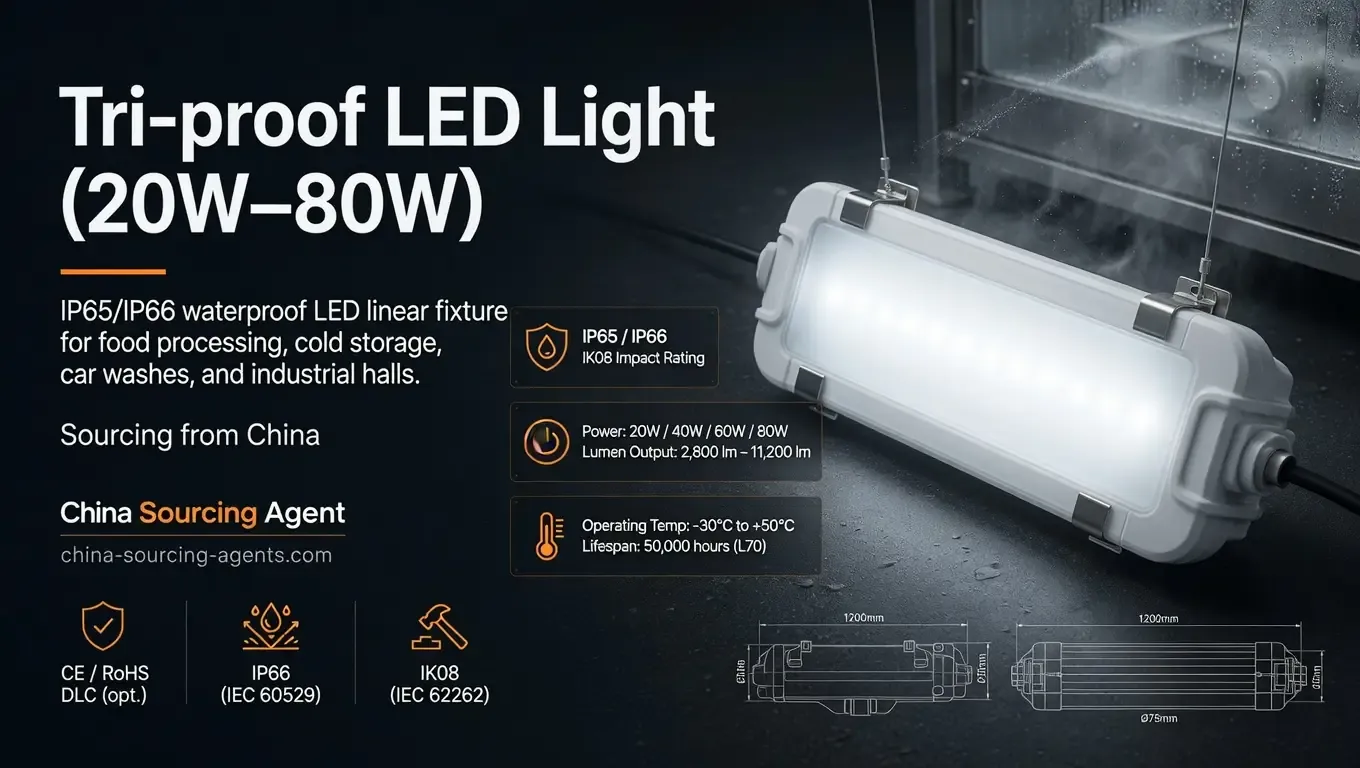
IP65/IP66 waterproof LED linear fixture for food processing, cold storage, car washes, and industrial halls. Corrosion-resistant PC housing, IK08.
 Reviewed by Martin Wang , Founder & Sourcing Engineer
 Published · Updated
What This Product Is
A tri-proof light (三防灯) is an LED linear fixture built to resist three specific hazards: water ingress, dust accumulation, and corrosion. The name comes directly from the Chinese designation for these three protection requirements, and the product category is essentially defined by its sealed, ruggedized enclosure rather than by a specific form factor or wattage. When sourcing tri-proof lights for industrial environments, enclosure construction is the primary differentiator between factories.
As a ruggedized category within LED lighting sourcing, the fixture is used wherever a standard LED batten or panel would fail within months. Typical environments include food processing plants where fixtures are hosed down daily with high-pressure water, cold-storage warehouses where condensation and temperature cycling degrade unsealed enclosures, car washes with constant moisture and detergent spray, chemical plants and fertilizer facilities with corrosive airborne compounds, livestock facilities with ammonia-rich atmospheres, parking garages with vehicle exhaust and occasional cleaning operations, and road tunnels with humidity and vibration.
Housing construction splits into two broad types. Full polycarbonate (PC) enclosures — body, end caps, and diffuser all in UV-stabilized PC — offer complete corrosion resistance in acidic, alkaline, or ammonia-heavy environments. This is the preferred choice for industrial IoT and food processing facilities. There is no exposed metal to oxidize, which makes PC the correct choice for food processing and chemical applications. The trade-off is thermal: PC has lower thermal conductivity than aluminum, so the LED driver and chip junction temperatures run higher at equivalent wattages. Well-designed PC fixtures address this by running lower-wattage chips at conservative drive currents, or by embedding a thin aluminum heat spreader inside the body.
Aluminum-plus-PC construction uses an extruded or die-cast aluminum body for heat dissipation with a PC diffuser and PC end caps. This gives better thermal performance at higher wattages (60W–80W) but exposes the aluminum body to corrosive atmospheres. In ammonia environments or marine applications, uncoated aluminum corrodes within one to two seasons. Anodized or powder-coated finishes extend service life but are not indefinite protection. For aggressive chemical environments, full PC is the safer specification — and for zoned hazardous areas with flammable gas or dust, an explosion-proof LED light with ATEX/IECEx certification is the correct category instead.
Continuous-run linkable versions use interlocking mechanical connectors and a daisy-chain wiring scheme that allows fixtures to be installed in long rows without visible gaps. This matters in food plant ceiling grids and tunnel installations where uniform illumination across a long run is required. Confirm that the linking system preserves the IP rating at the connection point — some linkable designs compromise the seal at the end cap.
Key Specifications to Specify
IP66 versus IP65. Both ratings require full dust exclusion (the “6” in the first digit). The difference is in water resistance: IP65 covers water jets from any direction at low pressure, while IP66 covers high-pressure and high-volume water jets. Food processing facilities that hose down ceilings and fixtures with pressure washers need IP66. A car wash tunnel with overhead spray needs IP66. Cold storage that sees only dripping condensation can accept IP65. Specify the correct rating in your purchase order — a factory may substitute IP65 for IP66 without notice if the order does not explicitly require IP66.
IK impact rating. IK08 corresponds to a 5 joule impact resistance per IEC 62262, equivalent to a 1.7 kg mass dropped from 300 mm. This is the standard minimum for areas with forklift traffic, where fixtures at ceiling-mounting height can be struck by raised loads or mast equipment. Parking garages, loading docks, and warehouse aisles fall into this category. IK07 (2J) is adequate for pedestrian-only areas.
Diffuser type. Clear PC diffusers transmit approximately 92–93% of the LED output, maintaining the advertised efficacy figure. Opal (frosted) diffusers scatter light more uniformly but absorb 8–12% more output, so the delivered lumen figure is lower than the chip specification. For food inspection areas and production lines where workers need to see color and surface detail clearly, opal gives more comfortable viewing but clear maintains higher illuminance at the task surface. Specify which you need and ask for photometric data for that specific diffuser.
Driver quality and surge protection. Industrial environments generate significant voltage transients from motor starts, relay switching, and power factor correction equipment. Specify a minimum 4kV surge protection rating on the driver (IEC 61000-4-5). Budget fixtures often use low-cost drivers with no surge protection, which leads to premature driver failure even when the LED chip itself is undamaged. Name-brand driver components (Inventronics, Meanwell, Sosen) are verifiable; request the driver model number and check the manufacturer datasheet. For power electronics applications, driver quality is the most common failure point in industrial lighting.
Color temperature and CRI for food inspection. General industrial applications work well at 5000K with Ra≥80. Fresh meat, fish, and produce inspection requires Ra≥90 to accurately render reds and greens — a Ra80 source will make meat appear darker and less appetizing, and will make spoilage harder to detect. If your end customer operates a food inspection line or fresh produce storage, specify Ra≥90 and 4000K (which renders food colors more naturally than 5000K in inspection contexts).
Emergency backup option. Some EU member states require emergency lighting in certain building types under EN 1838 and related national regulations. Battery-backed tri-proof versions use an integrated NiMH or LiFePO4 battery providing a minimum three-hour maintained emergency duration. If your destination market requires this, confirm the battery chemistry, cycle life (≥1,000 cycles), and self-test function before ordering.
Common Issues with Tri-proof LED Lights
IP rating certification fraud. The most common problem in this category is fixtures sold with IP65 or IP66 markings that were never independently tested. Self-declared IP ratings are not valid for CE marking under the Low Voltage Directive or the ErP Directive — the fixture must be tested by an accredited third-party laboratory to IEC 60529. A factory audit should verify the third-party test reports before production begins. Request the actual test report, not the CE declaration of conformity. The test report will identify the notified body or accredited lab, the test date, and the specific ingress protection tests performed. If a factory cannot produce a test report with a traceable lab identity, the IP rating is unverified.
PC yellowing and UV degradation. Standard polycarbonate yellows under UV exposure within two to three years, which reduces luminaire output and causes color shift. LED fixtures emit low-level UV, and indirect sunlight through skylights or translucent roofing panels accelerates the process. Specify UV-stabilized PC grade (common designations include Lexan EXL, Makrolon AL 2647, or equivalent with stated UV stabilizer package). Ask the factory for the PC material datasheet — legitimate manufacturers can provide the raw material specification. Non-UV-stabilized PC costs less and is frequently substituted without disclosure.
Condensation inside sealed fixtures in cold storage. A fixture sealed at ambient temperature in a warm factory and then installed in a cold-storage room at -20°C will experience significant temperature cycling as the room is loaded and defrost cycles run. If the gaskets degrade or were improperly installed, moist warm air enters during the warm phase and condenses on internal surfaces during the cold phase. Over months, this causes driver corrosion and light output reduction. Request temperature cycling test data per IEC 60068-2-14 or equivalent, and inspect the gasket groove depth and silicone hardness specification — gaskets that are too hard lose compliance and seal integrity at low temperatures.
Lumen depreciation in high-ambient-temperature environments. Published L70 lifespan figures (typically 50,000 hours) assume a specific ambient temperature, often 25°C. A food processing plant operating at 35°C ambient with poor ceiling airflow will significantly reduce the effective junction temperature headroom, accelerating LED depreciation. Ask for the fixture’s LM80 data and the thermal resistance from junction to ambient (Rja). If the factory cannot provide LM80 data for the specific LED chip at the operating drive current, the 50,000-hour claim is not substantiated. For more on vetting lighting manufacturers, see our factory audit checklist. For high-ambient installations, request a fixture with a conservative drive current (leaving 20–30% headroom below the LED chip’s rated maximum) to preserve lumen maintenance.
Tri-proof fixture manufacturing is concentrated in Zhongshan and Foshan, with suppliers that specialize in sealed polycarbonate extrusion and die-cast aluminium housings. Our sourcing service qualifies factories in these clusters that have accredited IP test reports and experience with food-plant and cold-storage specifications.
Submit an RFQ with mounting type, IP class, ambient temperature range, and destination market certifications.
Common questions
When should I specify IP66 instead of IP65 for tri-proof lights? +
IP65 covers low-pressure water jets; IP66 covers high-pressure, high-volume jets. Food plants that pressure-wash ceilings and car washes need IP66. Cold storage with only dripping condensation can accept IP65.
Which housing material is better for corrosive environments? +
Full polycarbonate (PC) enclosures resist acids, alkalis, and ammonia without exposed metal. Aluminum-plus-PC gives better thermal performance but corrodes in ammonia or marine atmospheres unless anodized or powder-coated.
What IK rating is needed for areas with forklift traffic? +
IK08 (5 joule impact resistance) is the practical minimum for loading docks, warehouse aisles, and parking garages where raised loads can strike fixtures. IK07 is adequate only for pedestrian areas.
Related knowledge
Have a sourcing project in mind?
Tell us what you need. We respond within 24 hours, including weekends.