ATEX/IECEx Explosion-Proof LED Light Manufacturer: 20W-200W
Source certified explosion-proof LED lights (20W-200W) from top China manufacturers. ATEX and IECEx approved for Zone 1 and Zone 2 hazardous areas. Ideal…
 Reviewed by Martin Wang , Founder & Sourcing Engineer
 Published · Updated
Understanding ATEX/IECEx Explosion-Proof LED Lighting
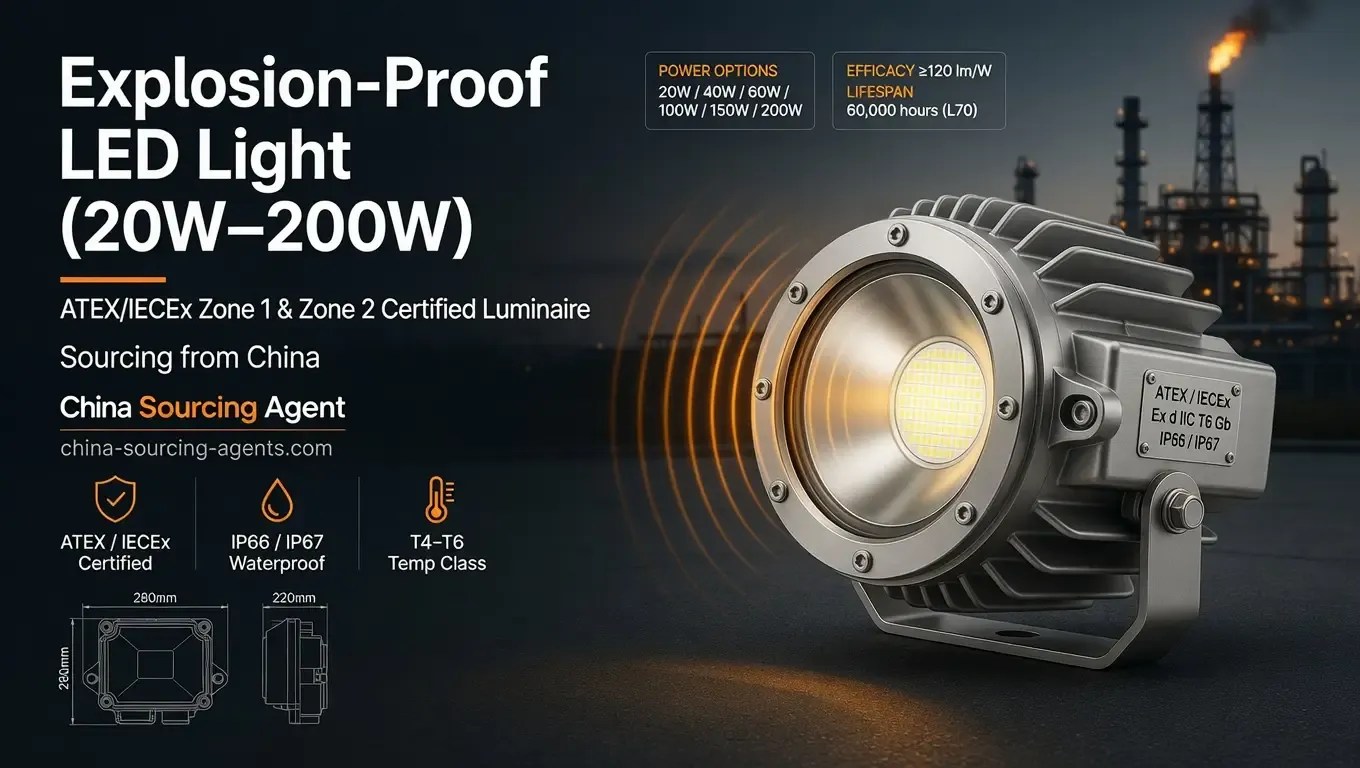
Explosion-proof LED lights and industrial lighting fixtures are certified luminaires designed for installation in hazardous environments where flammable gases, vapours, or combustible dusts may be present. The term “explosion-proof” is technically a North American designation (UL 844); in the IEC/ATEX system the equivalent concept is Ex d (flameproof enclosure). Both serve the same function: preventing an internal fault or arc from igniting the surrounding atmosphere.
The ATEX/IECEx zone classification system divides hazardous locations by how frequently an explosive atmosphere is present:
- Zone 0 — flammable gas or vapour is present continuously or for long periods during normal operation. Luminaires are not installed in Zone 0; ventilation and equipment layout avoid this zone entirely.
- Zone 1 — flammable gas or vapour is likely to be present during normal operation. Certified Ex d (flameproof) or Ex e (increased safety) luminaires are required.
- Zone 2 — flammable gas or vapour is not expected during normal operation but may occur in abnormal conditions. Ex d, Ex e, or Ex nA (non-sparking) luminaires are acceptable.
For combustible dust areas, the equivalent zones are Zone 20 (continuous dust presence — avoid luminaires), Zone 21 (dust present during normal operation — Ex tb or Ex d required), and Zone 22 (dust present only in abnormal conditions — Ex tc or Ex d acceptable). Relevant sites include grain silos, flour mills, sugar processing facilities, wood dust areas, and coal handling plants.
Typical applications for Zone 1/Zone 2 fixtures include petroleum refineries in the oil and gas industry, offshore oil and gas platforms, LNG terminals, floating production storage and offloading (FPSO) vessels, chemical storage facilities, petrochemical plants, pharmaceutical manufacturing areas with solvent exposure, paint spray booths, and tank farms.
The dominant protection concept for LED fixtures in Zone 1 is Ex d (flameproof enclosure): the housing is constructed so that if an internal ignition occurs — from an LED driver fault or wiring failure — the resulting pressure wave cannot escape to ignite the surrounding atmosphere. Joints and flamepaths are machined to tight tolerances specified in IEC 60079-1. The housing material matters: GRP (glass-reinforced polyester) is preferred over aluminum in H2S-rich, saline, or acidic environments because aluminum corrodes under prolonged H2S exposure, while GRP is chemically inert. 316 stainless steel is the alternative for the highest mechanical strength and chemical resistance requirements.
Ex e (increased safety) housings take a different approach: they are constructed to eliminate ignition sources entirely, so no arc or high surface temperature can occur inside. This is appropriate for terminal boxes and luminaire bodies where the internal components are inherently non-sparking. In practice, many modern LED fixtures combine concepts — an Ex d outer housing with an Ex e terminal compartment. For non-hazardous wet or impact-prone areas like car parks and food plants, an IP-rated tri-proof LED fixture covers the same robustness requirements without the cost of full Ex certification. These hazardous-area fixtures sit at the demanding end of the broader LED lighting supply chain, where most factories serve standard commercial and industrial applications.
Key Specifications for Hazardous Area LED Lights
Certification scheme. ATEX (EU Directive 2014/34/EU) and IECEx (International Electrotechnical Commission scheme) use the same underlying technical standards — the IEC 60079 series — but differ in administration. ATEX requires assessment by a European notified body and carries the Ex hexagon marking; it is legally required for equipment installed in EU member states. IECEx is the portable international scheme: certificates are issued by national certification bodies but are mutually recognised across IECEx participating countries. Many Chinese explosion-proof lighting manufacturers hold both ATEX and IECEx certificates on the same product, which is the most practical option for buyers targeting multiple regions.
Temperature class (T-class). The T-class defines the maximum surface temperature the fixture can reach under fault conditions. T4 (max surface temp <135°C) is sufficient for most petroleum hydrocarbons including propane, butane, and gasoline. T5 (<100°C) or T6 (<85°C) are required for substances with lower auto-ignition temperatures, such as carbon disulphide (T6 required). Specify the T-class based on the hazardous substance present at the installation site, not the most convenient option for the manufacturer.
Gas group. IEC 60079 divides flammable gases into groups by the minimum ignition energy and maximum safe gap: Group IIA (propane and similar — least restrictive), IIB (ethylene), IIC (hydrogen, acetylene — most restrictive). An IIC-rated fixture is certified for all gas groups. Unless the project engineer has documented that the site contains only IIA or IIB gases, specify Group IIC to avoid site-specific re-certification if the process changes.
Cable gland certification. The cable gland sealing the cable entry must itself carry an ATEX/IECEx certificate, and it must match the protection concept of the enclosure. An Ex e (increased safety) cable gland combined with an Ex d (flameproof) housing is a common incorrect combination that does not maintain the Ex d protection concept. Confirm the included glands are Ex d certified M20 or M25, matched to the certificate scope.
IP rating verification. Ex d housings typically achieve IP66 or IP67 by design — the flamepath tolerances that make the enclosure flameproof also exclude water ingress. However, the IP rating must be stated on the specific ATEX/IECEx certificate, not only on the product label. A factory can mark IP66 on the housing while the certificate covers only IP54 for a variant with a different gland configuration.
Common Sourcing Issues with Explosion-Proof Lighting from China
Certificate validity and scope. ATEX and IECEx certificates cover a defined scope: specific model variants, wattage ranges, housing configurations, and LED driver types. Our factory audit service verifies certificate validity directly against the IECEx Equipment Certificate Database (iecex.iec.ch) or the ATEX notified body’s public registry — fraudulent cloning of legitimate certificate numbers is a known and documented industry practice.
Non-certified “ATEX-style” products. Some Chinese factories manufacture fixtures that visually resemble certified Ex d luminaires — heavy cast housing, machined flamepath joints, Ex markings stamped on the body — without holding a valid certificate. Buyers unfamiliar with the certification system may accept the visual inspection and product datasheet as sufficient. They are not. Request the full certificate document, verify it against the public database, and confirm the model number on the certificate matches the model number on the purchase order line item.
Modification invalidates certification. ATEX and IECEx certification covers a specific bill of materials and production process. Substituting the LED driver, changing the LED module, or fitting a different cable gland — even if the replacement component is individually certified — voids the fixture’s certification unless the change is covered by a certificate amendment. Confirm with the factory that the production configuration covered by the certificate is the one being shipped, and request a Declaration of Conformity (DoC) and CE marking declaration tied to your specific order number and batch.
Spare parts availability. Explosion-proof fixtures are often installed in remote or offshore locations where sourcing replacement components is difficult and downtime is expensive. A Zone 1 fixture with a failed LED driver cannot be field-repaired with a generic driver — the replacement must be the exact certified variant. Before placing the order, confirm the factory can supply the same certified replacement drivers, LED modules, and cable glands for at least 10 years from purchase date, or negotiate a forward-stocked spare parts package as part of the initial order. For more on industrial-grade power electronics sourcing, see our industrial IoT page and power electronics page.
Sourcing notes from the floor
We audited two explosion-proof lighting suppliers last quarter and found ATEX certificate numbers that looked genuine but did not match the model variants on the production line. On recent projects we saw Ex d housings paired with Ex e cable glands, which breaks the flameproof path the certificate depends on. The most common spec mismatch is marking IP66 on the label while the certificate only covers IP54 for that gland configuration. Real-world MOQ/price is often 20 units at $120–650, with ATEX/IECEx dual certification adding 15–25% over single-certificate versions. Certification gotcha to watch: changing the LED driver, LED module, or gland voids the certificate unless the factory holds an amendment covering your batch.
Explosion-proof lighting factories are concentrated in Shenzhen, Ningbo, and the wider Guangdong industrial belt. A factory audit in these clusters verifies the certificate against the public ATEX/IECEx database and confirms the production configuration matches the certified bill of materials. For a broader view of lighting supplier geography, see our guide to the top LED light manufacturers in China.
Pricing for certified Ex d LED fixtures typically ranges from $120 for a 20W Zone 2 unit to $650 for a 200W Zone 1 IIC fitting, with ATEX/IECEx dual certification adding 15–25% over single-certificate variants.
Submit an RFQ with zone classification, gas group, temperature class, installation environment (indoor/outdoor, ambient temperature range), and required certifications.
Common questions
Do I need ATEX, IECEx, or both for hazardous-area LED lights? +
ATEX is mandatory for EU member states and requires a European notified body. IECEx is an international mutual-recognition scheme. Many Chinese manufacturers hold both on the same product, which is the most flexible option for multi-region projects.
How do I choose the right temperature class and gas group? +
T-class defines the maximum surface temperature under fault conditions — T4 (135°C) works for most hydrocarbons, while T6 (85°C) is needed for low auto-ignition substances like carbon disulphide. Group IIC covers all gas groups including hydrogen and acetylene; specify it unless the site engineer has documented a narrower gas profile.
Can the factory swap the LED driver or cable gland without invalidating certification? +
No. ATEX and IECEx cover a specific BOM and production configuration. Any driver, LED module, or gland substitution voids the certificate unless covered by an amendment. Confirm the shipped configuration matches the certificate scope and request a Declaration of Conformity tied to your batch.
Related knowledge
Have a sourcing project in mind?
Tell us what you need. We respond within 24 hours, including weekends.