Horticultural LED Grow Light 200W–1000W | China
Source full-spectrum commercial horticultural LED grow lights directly from China. Samsung LM301H, 2.5–3.0 µmol/J PPE for cannabis, vertical farms, and…
 Reviewed by Martin Wang , Founder & Sourcing Engineer
 Published · Updated
Understanding Horticultural LED Grow Lights for Commercial Cultivation
Horticultural LED grow lights are measured by a completely different set of metrics than general-purpose lighting. The standard lighting metric — lumens per watt (lm/W) — is irrelevant for plant applications. Lumens measure perceived brightness by the human eye, which is weighted toward green wavelengths. Plants use photons in the 400–700nm PAR (Photosynthetically Active Radiation) range, with red (620–700nm) and blue (400–500nm) driving the majority of photosynthesis. A supplier quoting lm/W for a commercial grow light is either uninformed or deflecting from actual agricultural performance.
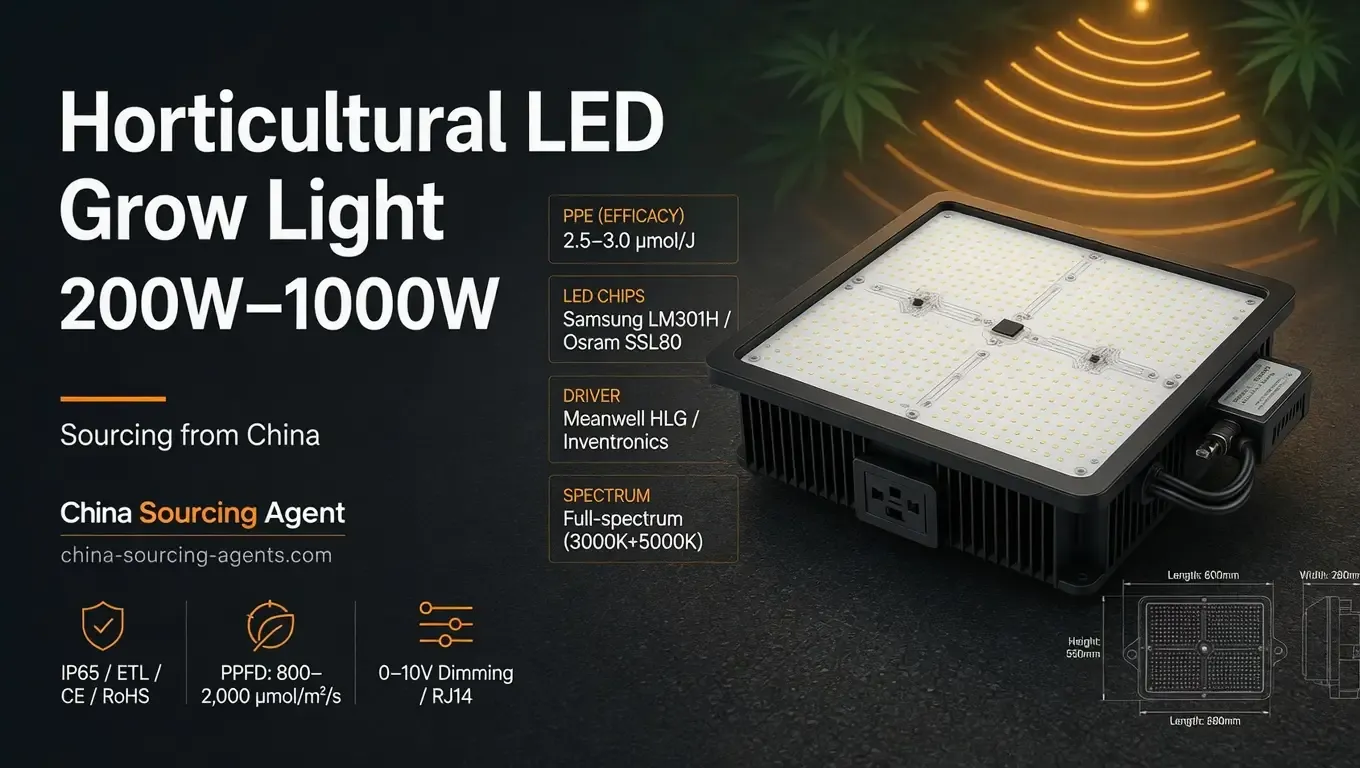
The three metrics that matter are PPF, PPFD, and PPE. PPF (Photosynthetic Photon Flux) is the total photon output of the fixture in µmol/s — a fixture-level number measured in an integrating sphere. PPFD (Photosynthetic Photon Flux Density) is the photon flux received at a specific point on the canopy, measured in µmol/m²/s at a stated distance and coverage area. PPE (Photon Efficacy) is the ratio of PPF to input wattage in µmol/J — the efficiency metric equivalent to lm/W in general lighting. PPE ≥2.5 µmol/J is the current commercial baseline; top-tier fixtures using Samsung LM301H at reduced drive current reach 3.0 µmol/J and above.
The dominant form factor in the market is the quantum board: a large-format aluminum PCB carrying many small, surface-mount LED chips spread across a wide area. This distributes heat across the entire board surface rather than concentrating it at a few high-power COB LED emitters. The result is lower junction temperatures, better L90 lifespan, and more uniform PPFD distribution across the canopy — critical for preventing hot spots in dense cultivation.
Application requirements vary significantly across the three main segments. Cannabis cultivation splits into two distinct growth stages: vegetative (18 hours on / 6 hours off, blue-dominant spectrum around 5000–6500K, target PPFD 400–600 µmol/m²/s) and flowering (12 hours on / 12 hours off, red-dominant spectrum around 2700–3000K, target PPFD 600–1,000 µmol/m²/s). Many commercial cultivators use a broad-spectrum white light throughout both stages and adjust photoperiod rather than spectrum, which simplifies fixture procurement. Leafy vegetables and herbs in vertical farms operate at lower PPFD — typically 200–400 µmol/m²/s — with tighter coverage requirements per rack tier. Propagation and seedling applications require the lowest PPFD (100–200 µmol/m²/s) but place the highest demand on uniformity, since a single tray may contain hundreds of cuttings that all need consistent light exposure.
Dimming control is standard on commercial-grade fixtures. The 0–10V analog input is the most common interface for integration with environmental controllers. RJ14 daisy-chain connectors allow multiple fixtures to be linked and controlled as a group from a single controller output, which simplifies large installation wiring. For seasonal demand patterns across grow lights and related fixtures, see our roundup of top LED and solar imports from China.
Key Specifications When Sourcing Commercial LED Grow Lights
PPE target. Specify PPE ≥2.5 µmol/J as a minimum acceptance criterion in your purchase order for commercial LED grow lights. PPE ≥3.0 µmol/J is achievable and worth the price premium for high-electricity-cost markets and large-scale greenhouse operations. The key to reaching 3.0 µmol/J is operating the LED chips at 50–65% of rated drive current. Running LEDs below their rated current improves wall-plug efficiency and significantly reduces junction temperature, which extends L90 lifespan. Factories that drive chips at full rated current to hit a wattage target will not reach top-tier PPE figures.
LED chip verification. Samsung LM301H and LM301B are the two most widely specified chips in this product category. Both have verifiable bin codes printed on the reel packaging and on individual chip markings. Request the Certificate of Analysis (COA) from Samsung for the specific reel batch used in your order. The COA will show the bin code, flux bin, forward voltage, and chromaticity coordinates. Match these against the chips on the finished PCB. Osram SSL80 is an acceptable alternative with comparable performance. Generic “Samsung equivalent” chips from Chinese fabs are not equivalent — they typically measure 10–20% lower PPE than Samsung chips at the same drive conditions.
Driver brand and testing. Meanwell HLG series and Inventronics are the two reference driver brands for this product. Both publish detailed efficiency curves and derating specifications. For any driver, request the efficiency at 100% and 75% load, and the derating curve showing output reduction at elevated ambient temperature. A driver rated at 480W at 25°C ambient will typically output 85–90% of rated power at 40°C — common in enclosed grow tents. This derating directly reduces the PPFD delivered at the canopy versus the fixture’s rated specification.
Spectrum documentation. Request a spectroradiometer measurement report showing the SPD (Spectral Power Distribution) curve. The SPD shows actual photon output at each wavelength between 380nm and 780nm. A marketing label reading “full spectrum” tells you nothing about the actual R:B ratio, the depth of green valley, or the presence of far-red (700–800nm) wavelengths that influence stem elongation and flowering response. For vegetative-stage fixtures, a blue peak (450nm) that is at least 20–30% of the red peak (660nm) is a reasonable baseline. For flowering, the red peak should dominate.
Thermal design. Ask for board temperature at rated load using a thermal camera image or thermocouple data. LED junction temperature should remain below 60°C at rated operating conditions (25°C ambient). Quantum boards typically achieve this with passive cooling, but the heatsink fin design and board-to-heatsink thermal interface material matter. Request the thermal pad or thermal paste specification — low-quality interface material adds 5–15°C to junction temperature.
DLC Horticulture listing. In the US market, DLC (DesignLights Consortium) Horticulture qualification unlocks utility rebate programs that can return $0.10–0.20 per µmol/s/day to the grower or installer. For a 640W fixture at 3.0 µmol/J producing ~1,920 µmol/s, the rebate can reach $140–280 per fixture. This makes DLC listing a significant procurement consideration for US commercial customers. Verify any DLC listing directly on the DesignLights Consortium QPL using the fixture model number — some suppliers reference outdated or incorrectly matched listings.
Common Issues and Pitfalls When Importing LED Grow Lights
PPE measurement fraud. PPE figures are only meaningful when measured per a published photometric test method in a calibrated integrating sphere by an accredited third-party laboratory. Demand a full IES LM-79-19 absolute photometry report from a lab holding ISO/IEC 17025 accreditation for that method — the same evidence DLC requires for its Horticulture QPL — and verify the reported PPF, PPE, and SPD against the model number you are buying. Reject any specification that rests only on a factory-conducted test, since uncalibrated in-house spheres are not traceable and cannot be cross-checked. Recognized labs include Intertek, TÜV, and UL.
Counterfeit Samsung diodes. The Samsung LM301H is the most counterfeited LED chip in the horticultural lighting market. Counterfeit chips are sold in bulk by several Chinese distributors and are physically identical to genuine Samsung chips under visual inspection. Genuine Samsung LM301H chips are supplied on 5,000-chip reels with a Samsung-printed box carrying the reel bin code. The bin code should be traceable through Samsung’s authorized distributor network. Sourcing through a verified Samsung authorized distributor adds a small premium to chip cost but eliminates the risk entirely. Request the distributor invoice with the Samsung reel serial number as part of your factory audit documentation.
Driver derating in high-ambient environments. As noted above, drivers derate at elevated ambient temperatures. This is not a defect — it is a specified behavior documented in the driver datasheet. The issue is that some fixture manufacturers specify PPFD at 25°C ambient but sell into applications where the driver enclosure reaches 40–50°C during operation. The actual delivered PPFD is then 10–15% below specification. Review the driver datasheet derating curve and adjust your PPFD expectations accordingly, or specify the ambient operating temperature at which the PPFD figure must be met.
IP rating inadequacy in humid environments. Cannabis and hydroponic production environments are high-humidity by design — relative humidity of 60–80% is standard during vegetative growth. An IP65 rating at the board level provides adequate moisture protection for the LED PCB. However, if the driver enclosure is only rated IP44 or IP20 (common on budget fixtures), moisture ingress at the driver causes premature failure within 6–12 months. For grow room applications, specify IP65 at the driver level, not just the board. Alternatively, select fixtures with remote driver mounting that positions the driver outside the humid canopy zone.
Horticultural LED fixture assembly is concentrated in Shenzhen and the surrounding Pearl River Delta, where driver, LED, and heatsink supply chains are within a few hours’ drive. Our sourcing service for LED lighting fixtures pre-qualifies factories in these clusters with verified Samsung distributor invoices and active DLC listings. A factory audit confirms that LED board assembly and thermal interface materials match approved samples, and pre-shipment inspection validates photometric test reports on the production batch. For a broader supplier map, see our guide to the top LED light manufacturers in China.
Sourcing notes from the floor
During a factory visit in Shenzhen we inspected horticultural LED fixtures and found LM301H reel paperwork that did not match the chips on the PCB — generic diodes measured 15–20% lower PPE than the Samsung batch they claimed. On recent projects we saw Inventronics drivers paired with IP44 housings in grow rooms running 70–80% RH, which failed within 12 months. The most common spec mismatch is quoting PPE at 25°C ambient when the driver derates 10–15% in a hot tent. Real-world MOQ/price is often 50 units at $80–380, with DLC Horticulture listing adding $0.10–0.20 per µmol/s/day in rebates. Certification gotcha to watch: DLC Horticulture QPL registration must match the exact fixture model, not a sibling SKU.
Submit an RFQ with target PPE, coverage area, crop type, and destination market.
Common questions
Why are lumens per watt irrelevant for horticultural LED lights? +
Lumens measure human-perceived brightness, weighted toward green. Plants use PAR photons in the 400–700 nm range, so specify PPE (µmol/J), PPF (µmol/s), and PPFD (µmol/m²/s) at a stated distance and coverage area.
How can I avoid counterfeit Samsung LM301H diodes? +
Request the Certificate of Analysis for the specific reel batch, verify the bin code against Samsung's authorized distributor network, and match markings on the finished PCB. Generic "Samsung equivalent" chips usually measure 10–20% lower PPE.
Is DLC Horticulture listing worth the cost for US buyers? +
Yes. DLC Horticulture qualification can unlock utility rebates of $0.10–0.20 per µmol/s/day. For a 640W fixture at 3.0 µmol/J the rebate can reach $140–280 per unit, so verify the listing directly on the DesignLights Consortium horticultural QPL.
Related knowledge
Have a sourcing project in mind?
Tell us what you need. We respond within 24 hours, including weekends.