Sourcing Air Conditioner Control Boards from China
How to source air conditioner control boards (DC inverter PCBA) from China — speccing the board, qualifying a factory, mains-voltage QC, and cost.
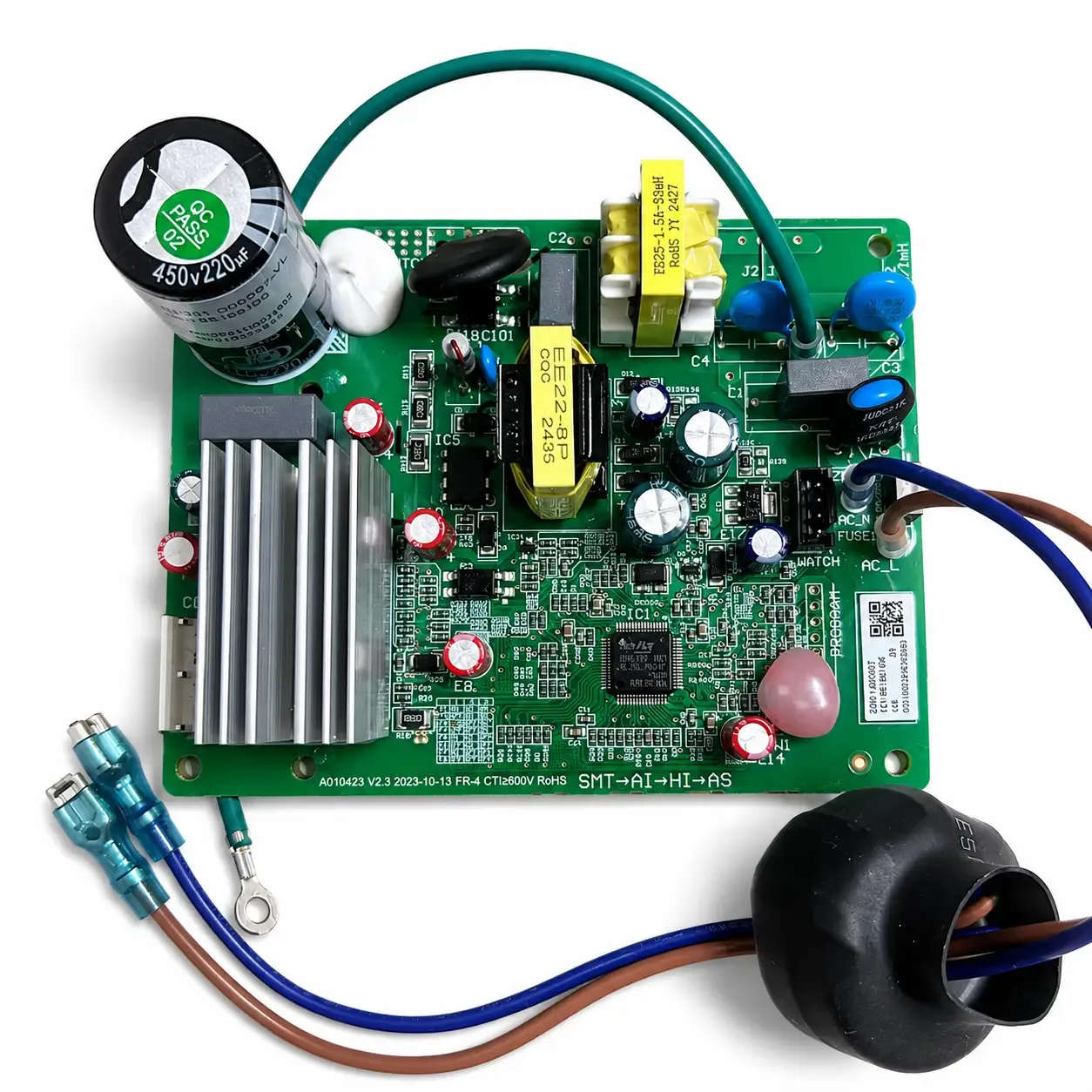
An air conditioner control board is a mains-voltage power-electronics PCBA, not a generic logic board — and that single fact changes how you source it. The board switches the compressor and fan, carries 220–310V on the inverter DC bus, and has to survive heat, humidity, and years of duty cycling inside an outdoor unit. Source it like an ordinary 2-layer board and you will get one that passes the factory’s visual check and fails in a customer’s wall a year later. The same discipline applies when sourcing a mini-split inverter AC unit or a smart thermostat with mains-voltage control boards.
This guide covers what a buyer needs to know before placing an order for air conditioner control boards in China, whether the end product is an AC unit, an air purifier, or another appliance with a high-voltage PCBA: what the board actually is, how to specify it so the quote is comparable, how to tell a contract manufacturer apart from a parts reseller, what mains-voltage quality control looks like, and what it really costs.
What an air conditioner control board actually is
There are two boards in a typical split air conditioner, and people use “control board” for both:
- Indoor unit main board — handles the user interface, temperature sensing, the indoor fan, and communication with the outdoor unit. Lower power, simpler.
- Outdoor unit control board (the inverter board) — this is the demanding one. It rectifies mains to a high-voltage DC bus, drives the BLDC compressor through an IPM (Intelligent Power Module) or discrete IGBTs, drives the outdoor fan, and runs the inverter control loop on an MCU. This is the board with the big bulk capacitor (commonly 450V 220µF or larger), the heatsink, and the current-sense shunt.
A concrete example: a board marked A010423 V2.3 FR-4 CTI≥600V RoHS is a TCL-family outdoor-unit inverter board. The silkscreen tells you a lot before you ever see a schematic — high-CTI FR-4 laminate, RoHS material set, a CQC mark on the transformer, and a 450V bulk cap that confirms it is a DC inverter design rather than a fixed-speed relay board. When a buyer asks us to source “an air conditioner control board,” the first job is to figure out which of these two boards they mean, because the sourcing path is completely different.
Why these boards are different from generic PCBA
If you have read our PCB assembly buyer’s guide, the fundamentals still apply — clean Gerbers, a complete BOM, an IPC class. But an AC inverter board adds constraints that a logic board does not have.
What does FR-4 CTI≥600V mean?
CTI is the Comparative Tracking Index, measured per IEC 60112. It is the voltage at which a material starts to form a conductive carbonized track across its surface when contaminated with water and dust. A higher number is safer. CTI≥600V is Material Group I, the top band — it lets you keep adjacent high-voltage traces closer together while still meeting the creepage distances in IEC 60335-1 appliance safety (the safety standard for household appliances).
This matters because an outdoor unit lives in humidity and dust. Standard low-cost FR-4 can be CTI 175V (Material Group IIIa). On a 310V DC bus, the difference between a CTI 175V and a CTI≥600V laminate is the difference between a board that tracks-and-arcs across a contaminated gap and one that does not. Common high-CTI laminates include KB-6160 and Shengyi S1600. Similar laminate-grade discipline matters in DC-DC converter modules and DIN-rail power supplies. Action: write the CTI grade explicitly into your fabrication notes and your purchase order — laminate is one of the easiest places for a factory to substitute silently, exactly as covered in our PCB substrate materials reference.
Mains voltage and creepage
Because the board switches mains and carries a high DC bus, the layout has to hold minimum creepage and clearance between live and safety-extra-low-voltage nets. A reputable factory will not change your copper, but a cut-rate one will “optimize” a board and quietly narrow a creepage gap to fit a cheaper outline. If you are licensing an OEM design like the A010423 family, keep the original copper and keepouts; if you are developing your own, get the creepage table reviewed during product development.
Power components drive the BOM risk, especially in products like panel radiators that combine heating elements with control electronics
The expensive, long-lead, and most-counterfeited parts on these boards are the IPM or IGBT module, the MCU, and the bulk electrolytic capacitor. The wiring between these power stages and the rest of the system often relies on terminal blocks or JST connectors, so specify the connector family and pinout in the BOM. A factory under cost pressure substitutes here first — a re-marked IPM or a 105°C cap swapped for an 85°C part. These substitutions pass a functional test on the bench and fail after a summer of thermal cycling.
How to specify the board so quotes are comparable
The single biggest cause of wildly different quotes is an incomplete package. Send the same complete package to every factory and the prices converge; send a vague request and you are comparing guesses. A complete package for an AC control board includes:
- Gerbers and a fabrication drawing with the laminate grade and CTI, copper weight (often 2 oz on the power side), board thickness, and surface finish.
- A full BOM with manufacturer part numbers — not “IPM, 600V” but the exact module. Mark which parts are critical and may not be substituted without written approval.
- An IPC-A-610 class. Class 2 is standard for appliance electronics; specify it so the factory does not assume the cheapest interpretation.
- A test specification — this is where AC boards differ most. Specify dielectric withstand (hipot) voltage and duration, functional test conditions, and whether you require burn-in.
- Conformal coating if the board sees condensation; specify the coating type and the keep-out areas (connectors, the heatsink interface).
If you cannot produce all of this yet — for example, you are reverse-sourcing a board you currently buy as a service part — say so up front. We have taken buyers from a single physical sample and a part number to a qualified production package; it is a normal first step, not a blocker.
Ask us on WhatsApp
Usually replies within a few hours during business hours.
Choosing a factory: contract manufacturer vs parts reseller
This is the distinction that the search results hide. Search “air conditioner control board” and the first page is dominated by replacement-part sellers — Amazon, eBay, AliExpress listings for boards like A010259 or A010423 at $130–190 each. Those are OEM service parts for an installed appliance. They are the right answer if your AC broke and you want the exact board back. They are the wrong answer if you are building a product or buying at volume.
What you want for volume is a PCBA contract manufacturer — a turnkey SMT assembly factory that builds your board to your BOM and test spec. The qualifying questions are the same ones in our factory audit checklist, plus a few specific to power electronics:
- Do they run in-circuit and functional test under load, not just AOI? An AC inverter board has to be tested driving a load, because a cold solder joint on a high-current path can pass at idle.
- Do they have hipot (dielectric withstand) testers on the line, and will they share the test log?
- Can they show traceability on the IPM and the bulk capacitor — reel labels, not a verbal assurance?
- Have they built mains-voltage appliance boards before, with CQC/CB experience? A shop that only does low-voltage IoT boards will struggle with the safety-critical layout review. The deepest concentration of this kind of capability sits with a Shenzhen sourcing agent network close to the IPM and capacitor supply base.
Run a factory audit before the first order if the value justifies it; check that the factory stocks compatible pin headers and Dupont cables for test fixtures if your design uses them, or at minimum a documented pre-shipment inspection with functional and hipot sampling on every batch.
What it actually costs
Per-board cost is built from three separable numbers: the bare PCB, the components, and the assembly-plus-test labor. For an outdoor-unit inverter board, the components dominate — the IPM, MCU, and bulk capacitor alone can be 50–70% of the bill. That is the opposite of the retail picture, where a single replacement board sells for $130–190 because it carries distribution margin and ships individually.
A real number for scale: a recent order we handled was 100 boards of a TCL-family A010423 outdoor-unit design. At that quantity, the setup, stencil, and program fees ($150–500 per run) still spread across only 100 boards, so the per-board cost sits well above where it would land at 1,000 units — but it is far below the retail replacement-part price, and it is a sensible pilot quantity to validate the factory before scaling. The lesson is the one that holds across PCBA: the first 100 boards prove the process; the price per board drops sharply once component reels and fixtures are amortized over a larger run.
Action: ask every factory to quote the PCB, components, and assembly separately, at two quantities (e.g. 100 and 1,000). The slope between the two tells you how much of the quote is fixed cost — and whether scaling actually pays off for your volume.
Quality control specific to AC control boards
Standard electronics quality control — AOI, visual to IPC-A-610, sampling per AQL — all applies. Add these because the board is mains-voltage power electronics:
- Hipot / dielectric withstand test, 100% (not sampled). Every board should pass a high-voltage test between primary and secondary. This is a safety test; do not accept sampling on it.
- Functional test under load. The board should be run driving a representative compressor/fan load, not just powered up. Idle tests miss high-current solder defects.
- Thermal verification on the power stage. Spot-check IPM and heatsink temperatures under load on a sample; a missing thermal pad or wrong grease shows up here.
- Component verification on critical parts. Cross-check the IPM, MCU, and bulk-cap markings against the approved BOM. Re-marked power semiconductors are a known counterfeit risk.
- Coating coverage if specified — UV inspection of conformal coating for skips around tall components.
Certification and compliance
Sort out which certificate applies to the board versus the finished appliance before ordering:
- RoHS — effectively mandatory for the EU, expected widely. The board’s silkscreen marking is not proof; get the material declarations.
- CQC / CCC — common for the China market and frequently present on transformers and the board itself.
- CE (EU) / UKCA (UK) — these apply at the appliance level under the Low Voltage and EMC Directives, but the board’s creepage, CTI, and component ratings are what make appliance certification possible. Get this right at the board and the appliance test goes smoothly.
- Safety construction per IEC 60335-1 — creepage/clearance, CTI of the laminate, and dielectric strength.
If your destination is multiple markets, plan the full certification set up front rather than re-testing later; our certification guide walks the EU and US paths.
Lead time, MOQ, and common risks
A first production run on a clean package is typically 3–5 weeks: 3–7 days for high-CTI FR-4 fabrication, 5–15 business days for assembly and test, plus component procurement if anything is out of stock. MOQ is usually set by component reels rather than the factory — expect a practical floor of 100–500 boards for a first run.
The risks that actually bite, in order:
- Silent laminate substitution — a cheaper CTI grade than specified. Catch it with a laminate certificate and, on high-value runs, a cross-section.
- Counterfeit or downgraded power parts — re-marked IPMs, 85°C caps in place of 105°C. Catch it with reel traceability and component verification.
- Narrowed creepage on a “re-optimized” layout. Catch it by locking the copper and reviewing the creepage table.
- Hipot sampled instead of 100%. Insist on 100% dielectric test in the PO.
Get those four into the purchase order and the test specification, and an AC control board sources as predictably as any other PCBA — it just has a lower tolerance for the shortcuts a cost-driven factory will otherwise take.
Next steps
If you are sourcing an air conditioner control board — whether you are reverse-engineering a service part you currently buy, licensing an OEM design, or building your own inverter board — start by nailing down which board you need and a complete package. From there, talk to us about qualifying a factory and running a pilot batch; a power-electronics sourcing engagement with proper hipot and functional test is the difference between a board that ships and one that comes back. The same supplier-matching discipline underpinned a recent EU industrial IoT gateway project we ran. For projects that also need distribution transformers, see our guide to power transformer manufacturers in China.
Ask us on WhatsApp
Usually replies within a few hours during business hours.
