AQL Sampling Plans: How to Use the Table for Electronics Inspection
Practical guide to AQL (Acceptable Quality Level) sampling plans per ANSI/ASQ Z1.4 for electronics pre-shipment inspection. Covers lot size to sample size lookup, defect classification, and how to interpret pass/fail decisions.
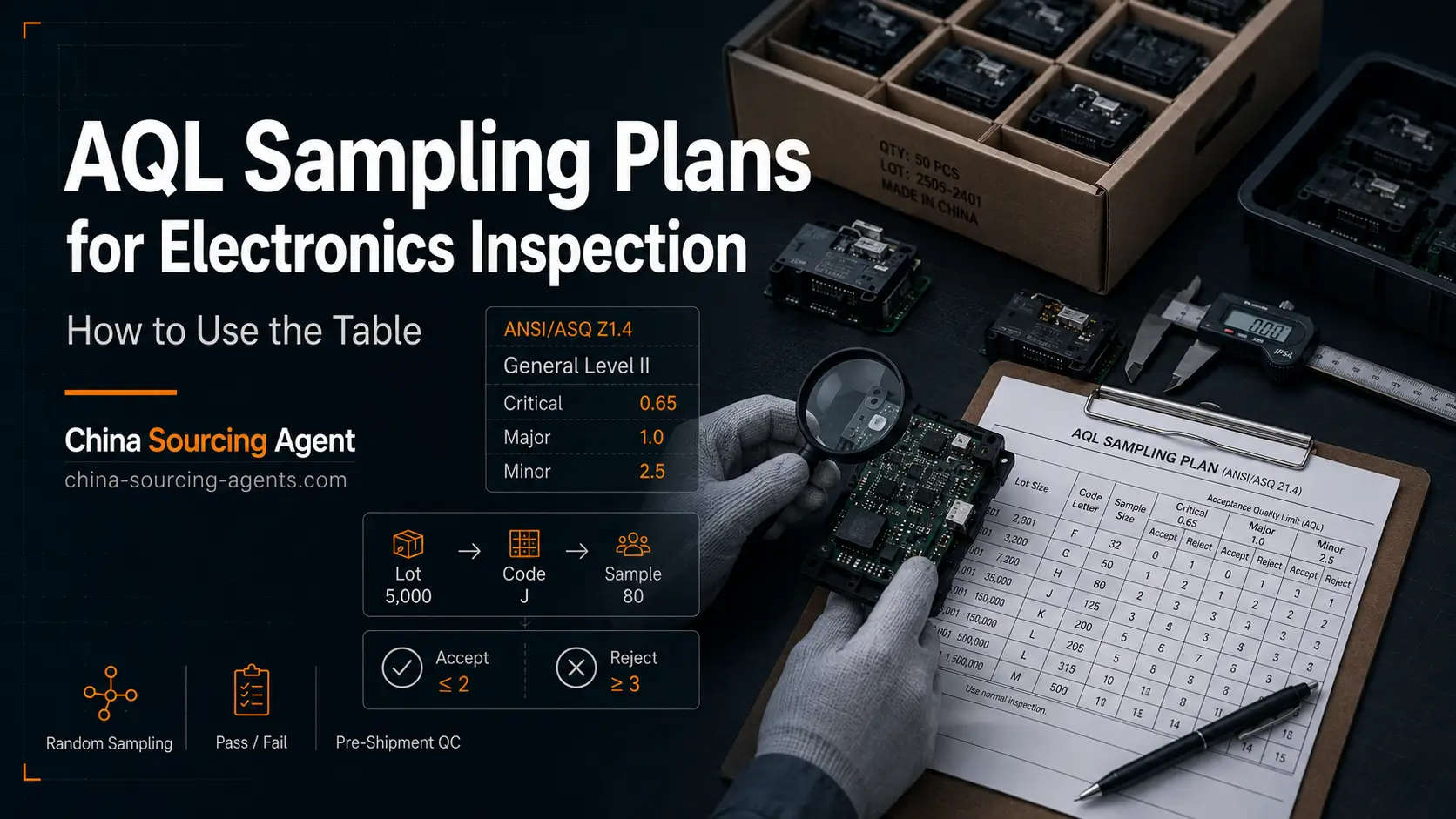
AQL sampling is the industry-standard method for deciding whether to accept or reject a production lot based on inspecting a statistical sample. Every buyer sourcing electronics from China needs to understand how to use the AQL table — it determines how many units to inspect, how many defects are tolerable, and what happens when the lot fails. AQL is the operational backbone of any professional pre-shipment inspection engagement.
Overview
AQL (Acceptable Quality Level) is defined in ANSI/ASQ Z1.4 (attribute sampling, used for pass/fail decisions on electronics) and ANSI/ASQ Z1.9 (variables sampling, used for measurable characteristics). The AQL value does not mean “every lot will have this defect rate.” It means “in the long run, lots submitted at this defect rate will be accepted about 95% of the time.” It’s a long-run process quality index, not a per-batch guarantee.
The standard distinguishes defect severity: Critical (safety hazard, regulatory non-compliance), Major (likely to fail or cause customer return), and Minor (workmanship imperfection, unlikely to affect function). You apply different AQL levels to each class — and you must define which defects fall into which class before inspection begins, in writing, in the inspection agreement.
Key Parameters
| AQL Level | Defect Class | Typical Application |
|---|---|---|
| 0 | Critical | Zero tolerance — any critical defect = reject lot |
| 0.065 | Critical | Very tight — used for medical, safety-critical |
| 0.65 | Critical | Standard for critical defects in electronics |
| 1.0 | Major | Standard major defect AQL for CE/FCC markets |
| 2.5 | Minor | Standard minor/cosmetic defect AQL |
| 4.0 | Minor | Acceptable for less visible cosmetic items |
| Inspection Level | Sample Size | Use Case |
|---|---|---|
| General I (G-I) | Smaller sample | Low-risk, established supplier, stable process |
| General II (G-II) | Standard | Default for most pre-shipment inspections |
| General III (G-III) | Larger sample | New supplier, first production run, high-risk |
| Special S-1 to S-4 | Very small | Destructive testing, expensive testing per unit |
How to Use the AQL Table — Step by Step
Step 1: Determine lot size. This is the total number of units in the production run being inspected — not the total order size if it spans multiple runs.
Step 2: Select inspection level. Default is General Level II (G-II) for most pre-shipment electronics inspections.
Step 3: Find the sample size code letter. Use the lot size + inspection level to look up the code letter in Table 1 of ANSI/ASQ Z1.4.
Common code letters for G-II:
| Lot Size | Code Letter | Sample Size (G-II) |
|---|---|---|
| 2–8 | A | 2 |
| 9–15 | B | 3 |
| 16–25 | C | 5 |
| 26–50 | D | 8 |
| 51–90 | E | 13 |
| 91–150 | F | 20 |
| 151–280 | G | 32 |
| 281–500 | H | 50 |
| 501–1,200 | J | 80 |
| 1,201–3,200 | K | 125 |
| 3,201–10,000 | L | 200 |
| 10,001–35,000 | M | 315 |
| 35,001–150,000 | N | 500 |
Step 4: Find accept/reject numbers. Look up the code letter in Table 2 (single sampling, normal inspection) at your chosen AQL level.
Example: 5,000 unit lot, G-II, AQL 1.0 for major defects.
- Lot 5,000 → Code J → Sample size: 80 units
- At AQL 1.0: Accept if ≤ 2 defects, Reject if ≥ 3
- This means: inspect 80 randomly selected units. If you find 2 or fewer major defects, accept the lot. If you find 3 or more, reject it.
Example 2: 5,000 unit lot, G-II, AQL 2.5 for minor defects.
- Same Code J, 80 units
- At AQL 2.5: Accept if ≤ 5, Reject if ≥ 6
Tightened and Reduced Inspection
ANSI/ASQ Z1.4 includes switching rules. If a supplier fails 2 of 5 consecutive lots on normal inspection, switch to tightened inspection (smaller accept numbers — more sensitive). After 5 consecutive lots pass tightened inspection, switch back to normal. After 10 consecutive lots pass normal inspection, switch to reduced inspection (smaller sample size). These switching rules reward consistently good suppliers and quickly catch deteriorating processes — use them if you have ongoing volume with a single factory.
Defect Classification — Define This in Writing
Before the inspection, you and your inspector (or third-party QC firm) must agree on a defect list. Example classifications:
Critical defects (AQL 0 or 0.65):
- Exposed live conductors accessible to end user
- Missing regulatory marking (CE, FCC ID) on product
- Battery polarity reversal possible without user intervention
- Any safety function disabled
Major defects (AQL 1.0):
- Unit powers on but primary function fails
- Charging does not work
- Button/switch mechanically broken
- Incorrect language on UI or label
Minor defects (AQL 2.5–4.0):
- Cosmetic scratches not visible in normal use
- Minor paint drips on non-visible surface
- Slight variation in LED brightness (within spec)
- Minor flash on plastic (not sharp)
What Happens After a Rejection
When the inspector’s sample fails at any defect class, you have three options:
- 100% sort: Factory manually inspects every unit, removes/repairs defective ones, then resubmit for re-inspection. Cost is borne by factory. Expect 5–10 days delay.
- Rework and re-inspection: Factory fixes the defective units (e.g., re-labels, re-tests). Re-inspection is typically at tightened level.
- Reject the lot: Refuse shipment. Factory must produce a new lot or repair and fully re-inspect.
Always document the rejection in writing with the inspection report attached. Do not verbally agree to accept a failed lot “because it’s mostly okay” — this weakens your position for future lots.
What to Specify When Ordering from China
- Inspection reference standard: ANSI/ASQ Z1.4, Single Sampling, Normal Inspection
- Inspection level: General Level II (state this explicitly — inspectors default to this, but some use G-I which gives smaller samples)
- AQL by defect class: e.g., “Critical: 0.65, Major: 1.0, Minor: 2.5”
- Defect classification list: attached as an appendix to the PO or quality agreement — never leave this verbal
- Sampling must be random: inspector selects units from across the production run, not from boxes the factory presents
Quality Checks
The biggest process control failure is non-random sampling. If a factory pre-stages “good” units for inspection, the statistical assumptions of AQL sampling are violated and the accepted lot may not reflect the true lot quality. A professional third-party inspector (SGS, Intertek, QIMA, or equivalent) will break carton seals from multiple pallet positions and select randomly. When hiring a third-party inspection service, verify that their inspection report documents the carton numbers and positions from which samples were drawn.
Cost for a single pre-shipment general inspection (AQL per Z1.4): $200–400 for a standard electronics lot, including report same day. Third-party inspection is almost always cheaper than the rework cost from accepting a bad lot. For PCB assembly runs, combining AQL sampling with a factory audit on new suppliers provides the strongest risk coverage.
Common Issues
Inspector selects convenience sample: Units from the top of the nearest pallet. Biased toward units the factory may have placed there. Solution: require carton selection from random positions and document box numbers in the report.
AQL level applied inconsistently: Factory claims “we passed AQL inspection” but used AQL 4.0 for everything including critical defects. Always specify the AQL level by defect class in the purchase agreement, not just “AQL inspection.”
Lot failure ignored: Buyer accepts the lot anyway under time pressure and factory promises rework. Defective units still ship. Solution: do not accept the shipment until a re-inspection report shows pass. Factor lead time contingency into your schedule for this scenario.
Related Resources
- IPC-A-610 Acceptance Criteria — defines what constitutes a defect on PCBAs
- SMT Assembly Process — process context for PCBA defects
- X-Ray Inspection — destructive/semi-destructive inspection for hidden joints
- Factory Audit Checklist
- How to Source Electronics from China
- Quality Inspection Services
- Factory Audit & Verification
- PCB Manufacturing & SMT Sourcing