LED Flood Light (50W–1000W)
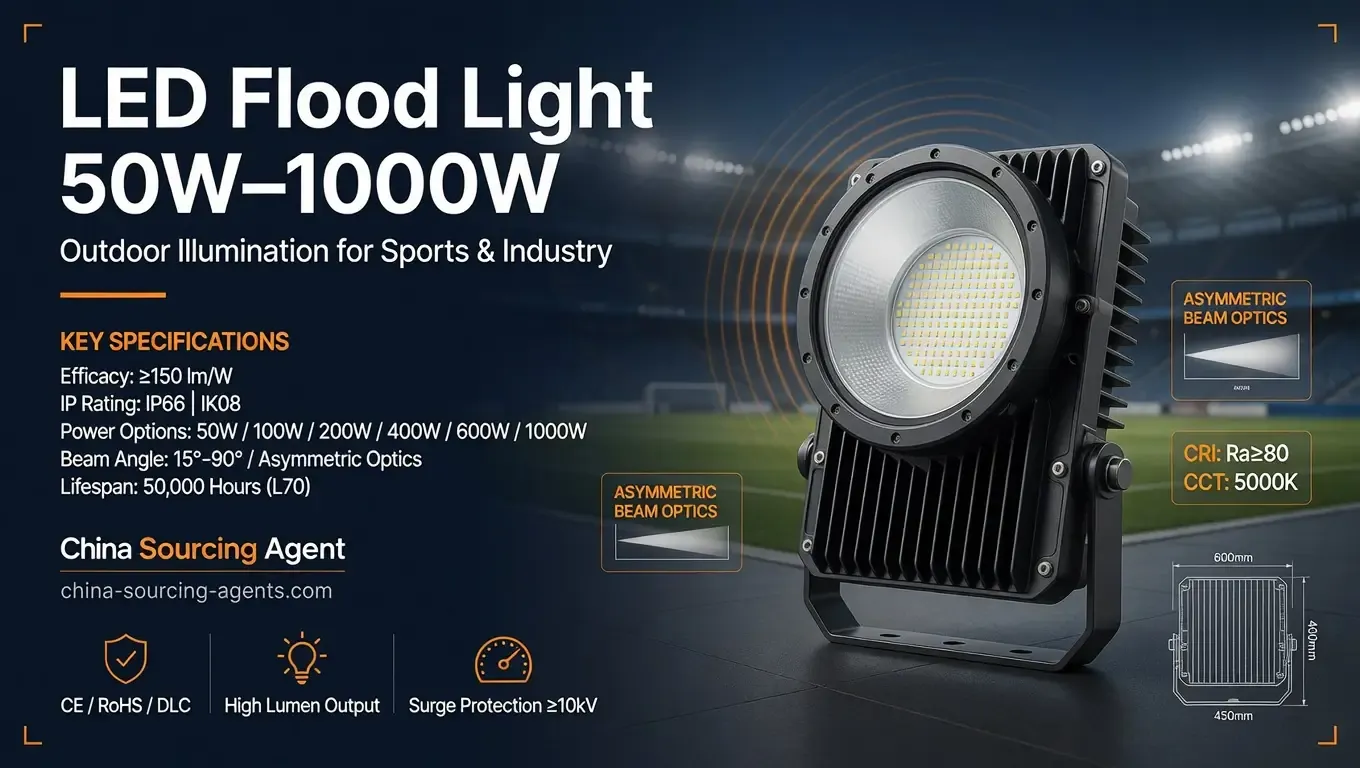
Outdoor LED flood light for sports fields, construction sites, and parking lots. IP66, 150+ lm/W, asymmetric beam optics available.
What This Product Is
LED flood lights cover a wide range of outdoor area illumination applications, differentiated primarily by wattage, beam optics, and the structural demands of the mounting environment.
Sports lighting is the most technically demanding segment. Football and soccer fields, athletics tracks, and tennis courts require precise photometric control to meet standards such as EN 12193 (Europe) or IESNA RP-6 (North America). The critical distinction here is beam optics: symmetric beam profiles distribute light in a cone centered on the fixture’s optical axis, which is adequate for general area lighting but unsuitable for sports fields. Asymmetric optics reshape the beam to concentrate illuminance on the playing surface at a distance while controlling spill light and glare toward spectators and neighboring properties. A 400W fixture with asymmetric optics on a 20-meter pole can deliver uniform horizontal illuminance across a field at 200 lux or higher while keeping the glare rating within competition limits. Sports applications above recreational club level typically require a lighting designer to produce a photometric calculation — using software such as AGi32 or DIALux — before the fixture count, wattage, pole positions, and aiming angles are finalized. Specifying flood lights without this step routinely results in either under-illuminated surfaces or excessive glare.
Construction site temporary lighting uses higher-wattage symmetric flood lights (200W–1000W) on portable stands or scaffold-mounted brackets. Requirements here are practical: robust housing (IK08 minimum), fast deployment with standard cable connections, and acceptable efficacy to reduce generator fuel consumption on sites without grid power.
Building and facade floodlighting uses narrower beam optics — 15° to 30° — to wash architectural surfaces from ground-mounted or parapet-mounted fixtures. Color temperature selection matters: 4000K reads as neutral white on stone and concrete, while 3000K–3500K (warm white, less common in Chinese factory standard offerings) flatters brick and timber. Facade applications often require ENEC or similar third-party certification for projects in the EU public sector.
Parking lots and perimeter security lighting use wide-beam fixtures (60°–90°) on poles at 8–12 meters. The primary requirement is maintained horizontal illuminance uniformity — EN 13201 uniformity ratios — rather than peak lux.
Industrial yard lighting at logistics facilities, ports, and refineries covers large areas from high poles (20–30 meters) and demands high-surge-protection ratings and wide operating temperature tolerance given the uncontrolled outdoor environment.
Key Specifications to Specify
Specify minimum lumens, not watts. Wattage tells you power consumption; it says nothing about how much useful light the fixture produces. Two 400W flood lights from different factories can have a 30% difference in delivered lumens. Our sourcing service helps you specify minimum initial lumens and request IES photometry files to verify — a step that separates spec-sheet performance from real-world output. For high-wattage installations, see our power electronics page for driver thermal management and surge protection guidance.
Color rendering for sports broadcast. Standard outdoor flood lights ship at Ra≥70 CRI, which is acceptable for general illumination. Sports venues with broadcast television coverage require Ra≥80 because color cameras used for ball tracking and match broadcast need accurate color rendering to distinguish the ball, player kits, and field surface. Specify Ra≥80 explicitly for any sports application — factories will not upgrade to higher-CRI LEDs automatically, and the bin cost difference is meaningful.
Surge protection is not optional for pole-mounted fixtures. A flood light on a 20-meter steel pole is an efficient lightning collection point. The minimum acceptable surge protection for outdoor pole-mounted applications is ≥10kV/10kA per IEC 61643-11. Lower-cost fixtures either omit surge protection entirely or install a token device rated at 2kV/2kA. Ask for the SPD component datasheet and verify the rated values match the fixture spec sheet.
Thermal management in high-wattage units. For 400W–1000W fixtures, driver thermal management is often the limiting factor for lifespan, not the LED board. Die-cast aluminum heatsinks should have fin depth of at least 25mm to allow natural convection. Thermal interface between the LED board and heatsink must be thermal grease — not thermal tape. Thermal tape degrades and separates in outdoor temperature cycling. Request photos of the disassembled fixture and the driver operating temperature at rated load before approving samples.
Glare rating for sports and public spaces. The EU standard for sports lighting is GR (Glare Rating) per CIE 112. Maximum GR 50 applies to recreational sports, GR 45 for competition-level play. GR is a calculated value that depends on fixture luminance, beam distribution, mounting height, and observer position — it cannot be determined from a fixture spec sheet alone and requires photometric software. If the factory claims a GR value on their spec sheet, ask for the calculation conditions; GR stated without a defined scenario is meaningless.
Driver controllability. Multi-use facilities need different illuminance levels for training (lower, energy-saving mode) versus competition (full output). 0–10V dimming input is the standard interface for this on Chinese-manufactured drivers. Confirm the dimming range — some drivers dim only to 30% minimum output, which may not satisfy energy management requirements.
Common Issues
IP66 housing with non-IP cable glands is not an IP66 installation. The most common IP rating failure in field installations is the cable entry point. The fixture housing may have a genuine IP66 gasket seal on all joints, but if the installer uses a standard non-rated cable gland or leaves a conduit entry open, the IP rating of the complete installation is zero. Specify IP66 cable glands explicitly in your purchase order and confirm that the factory supplies them with the fixture. Check the installation manual — if it does not reference conduit sealing, assume the factory has not tested the complete cable entry.
Driver heat in high-wattage fixtures. At 400W and above, the driver generates substantial heat internally. Driver enclosures in cheaper fixtures are often undersized for the thermal load, leading to electrolytic capacitor degradation and premature failure. Ask for the driver’s rated operating temperature (junction temperature, not ambient temperature) and request data on driver derating at elevated ambient temperatures. A driver rated at full output only up to 40°C ambient will derate or fail on a south-facing wall in summer in the Middle East or Southern Europe.
Polycarbonate lens yellowing under UV exposure. Many flood lights ship with polycarbonate diffuser lenses as a cost measure. Polycarbonate yellows progressively under UV exposure in outdoor installations, typically becoming visible within 3–5 years and measurably reducing luminaire output within the same period. For permanent installations — sports facilities, facades, industrial sites with a 10-year asset life expectation — specify tempered glass lens. The cost premium per fixture is modest relative to the installation cost.
Wind load and structural mounting data. A 1000W flood light is a physically large object — typically 600mm to 800mm across the heat sink — and presents significant drag area when mounted on a tall pole. Structural calculations for poles and brackets must account for both the fixture weight and its drag coefficient in wind. Chinese flood light factories rarely provide wind load data or certified mounting load calculations with their products. Our audit service can obtain wind load data directly from the factory’s mechanical engineer and our inspection service verifies IP66 cable gland compatibility, SPD ratings, and lens material on pre-production samples. This is a regulatory requirement in most European and North American jurisdictions for publicly accessible installations.
Submit an RFQ with application type, mounting height, required lux level or lighting standard, and destination market certifications.
Van egy beszerzési projektje?
Mondja el, mire van szüksége. 24 órán belül válaszolunk, hétvégén is.