77GHz Radar Sensor Modules for ADAS: Sourcing from China
Technical sourcing guide for 76–81 GHz FMCW radar modules used in ADAS. Covers TI AWR/NXP TEF810x chipsets, Chinese OEMs, AEC-Q100 verification, and FCC/ETSI compliance.
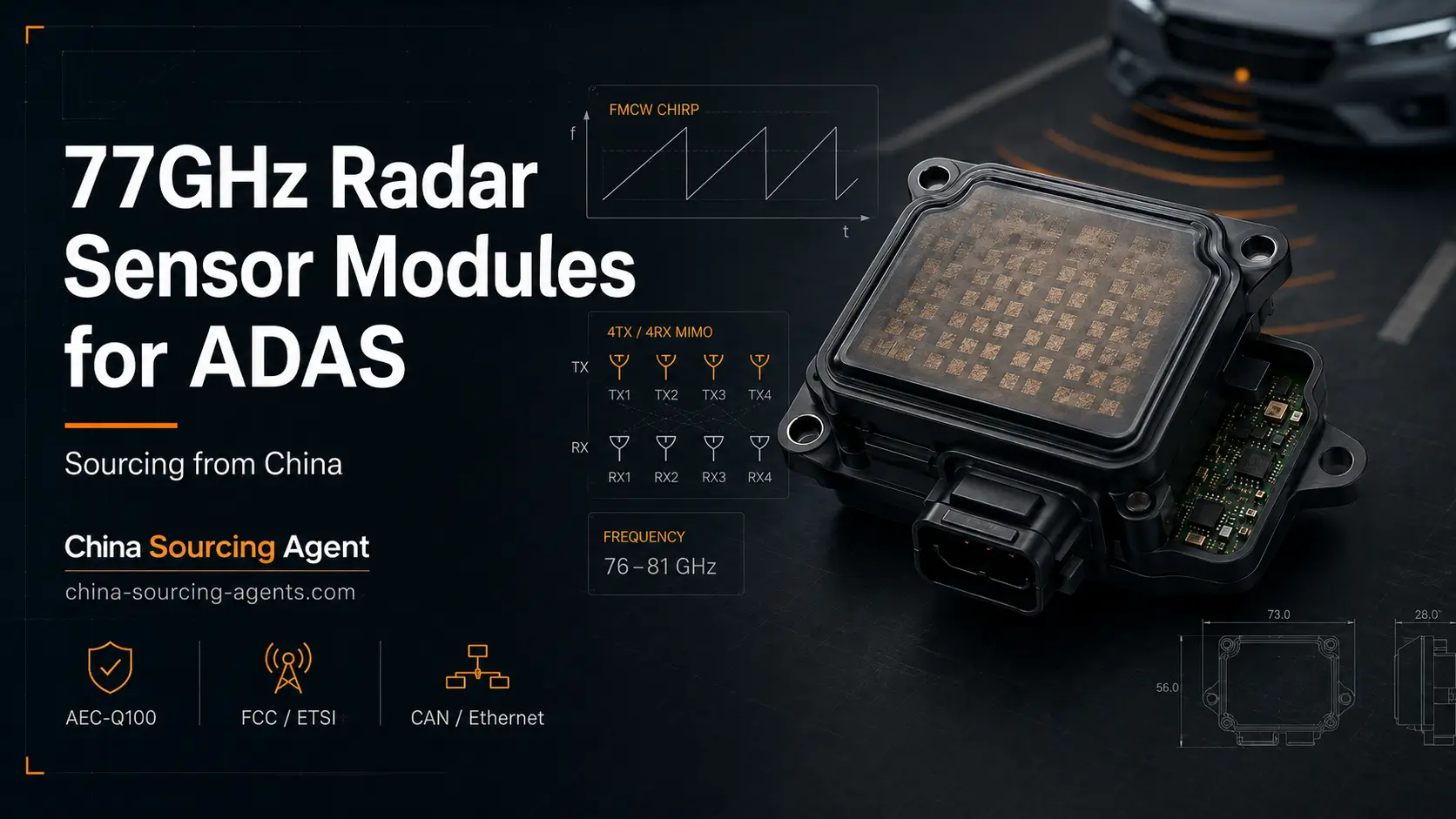
77 GHz FMCW radar is one of the hardest automotive electronics categories to source responsibly from China. The chipsets are real, the Chinese module OEMs are real — but the AEC-Q100 qualification gap between commercial and automotive-grade silicon is consistently misrepresented by lower-tier suppliers. For any ADAS application, verifying the actual qualification grade of the radar IC before production commits is not optional.
Overview
Millimeter-wave radar sensors operating in the 76–81 GHz band (ITU-R RA.769 allocated) are the dominant sensing modality for automotive adaptive cruise control (ACC), automatic emergency braking (AEB), blind-spot detection (BSD), and lane-change assist (LCA). Unlike cameras, they operate reliably in rain, fog, dust, and darkness. Unlike LiDAR, they directly measure radial velocity via the Doppler effect with no post-processing required.
The operating principle is FMCW (frequency-modulated continuous wave): a chirp signal sweeps linearly from ~76 GHz to ~81 GHz, and the beat frequency between the transmitted and received signal encodes both range and velocity simultaneously. A single CW pulse cannot do this — the FM sweep is what makes FMCW practical for automotive use.
FMCW radar modules integrate the transceiver front-end (TX/RX antennas, millimeter-wave IC), a DSP/MCU for signal processing, and a vehicle interface (CAN, SPI, Ethernet) into a weatherproof enclosure rated for automotive vibration and temperature profiles.
Key Specifications
| Parameter | Short-Range (SRR) | Mid-Range (MRR) | Long-Range (LRR) |
|---|---|---|---|
| Typical range | 1–30 m | 1–80 m | 30–250 m |
| Range resolution | 0.15–0.30 m | 0.20–0.40 m | 0.30–0.50 m |
| Velocity resolution | 0.1–0.3 m/s | 0.1–0.2 m/s | 0.05–0.15 m/s |
| Horizontal FoV | 120–180° | 45–100° | 15–30° |
| Vertical FoV | ±15° | ±10° | ±5° |
| Angular resolution | 3–5° | 2–4° | 1–3° |
| Update rate | 20–50 Hz | 20–50 Hz | 10–20 Hz |
| Operating temp | −40°C to 85°C | −40°C to 85°C | −40°C to 85°C |
| Supply voltage | 12V (±10%) | 12V (±10%) | 12V or 24V |
| Power consumption | 2–4 W | 4–8 W | 6–15 W |
Angular resolution is determined by the virtual aperture created by the MIMO antenna array — not by the RF band alone. A 4T4R (4 transmit, 4 receive) antenna achieves 16 virtual antenna elements, giving roughly 4× better angular resolution than a 1T4R configuration at the same aperture size.
Main Variants / Types
Chipset Families
Texas Instruments AWR Series (AEC-Q100 Qualified)
The TI AWR family is the most widely used automotive radar chipset globally and the benchmark for AEC-Q100 Grade 1 qualification in this category.
| IC | TX/RX | Max Bandwidth | Key Feature | AEC-Q100 Grade |
|---|---|---|---|---|
| AWR1642 | 2TX / 4RX | 4 GHz | Integrated ARM R4F + DSP C674x, CAN/SPI output | Grade 1 (−40 to 125°C) |
| AWR1843 | 3TX / 4RX | 4 GHz | Embedded ARM R4F + DSP C674x, LVDS output, higher processing headroom | Grade 1 |
| AWR2944 | 4TX / 4RX | 4 GHz | 16-virtual-element MIMO, PCIe Gen2 output, highest performance AWR device | Grade 1 |
| AWR6843 | 3TX / 4RX | 4 GHz | Single-chip with integrated MCU, simplified BOM for volume cost | Grade 1 |
TI provides full mmWave SDK, DNN model integration for point cloud classification, and reference designs (TIDEP-01012 for corner radar). AEC-Q100 Grade 1 covers the junction temperature range −40°C to 125°C, which is the standard automotive underhood/bumper requirement.
Infineon RASIC / BGT Series
Infineon’s RASIC (Radar Single Chip) family dominates the Tier 1 OEM supply chain (Bosch, Continental, and ZF all use RASIC derivatives in production vehicles).
| IC | Configuration | Notes |
|---|---|---|
| BGT60TR13C | 1TX / 3RX | 60 GHz (ISM band), primarily industrial/gesture; not automotive-grade |
| RXS8160PL | RASIC transceiver | Used in Bosch LRR4; not publicly available for independent sourcing |
| RASIC5 | 4TX / 4RX | OEM-only supply; not available on open market |
Infineon RASIC is effectively not sourceable outside Tier 1 automotive channels. AWR and NXP TEF810x are the practical chipset options for development modules and lower-tier ADAS integration.
NXP TEF810x Series
| IC | Configuration | Notes |
|---|---|---|
| TEF8100 | 2TX / 4RX | 76–77 GHz, CAN FD interface, AEC-Q100 Grade 1 |
| TEF8102 | 4TX / 4RX | 76–81 GHz, MIPI CSI-2 or Ethernet output |
NXP TEF810x is used in some Valeo and Aptiv radar designs. Less common in Chinese development modules but available from NXP Semiconductors directly.
Antenna Array Configurations
| Configuration | Virtual Elements | Angular Resolution (typ.) | Typical Application |
|---|---|---|---|
| 1TX / 4RX (1T4R) | 4 | 5° | Basic BSD, parking aid |
| 2TX / 4RX (2T4R) | 8 | 3° | MRR, ACC with limited angular precision |
| 3TX / 4RX (3T4R) | 12 | 2° | Full-feature MRR/SRR combo |
| 4TX / 4RX (4T4R) | 16 | 1.5° | LRR with full MIMO aperture, AEB-capable |
Virtual aperture (MIMO processing) allows a physically compact antenna to achieve angular resolution equivalent to a much larger real aperture. The 4T4R configuration on the AWR2944 achieves ~1.5° horizontal resolution in a module roughly 80mm × 60mm.
Interface Variants
- CAN / CAN FD: Object list output (x, y, velocity, RCS). Standard for vehicle integration. 500 kbps–2 Mbps.
- SPI: Raw ADC data or CFAR-processed detections. Used in development kits.
- UART: Debug and configuration only; not for production point cloud output.
- Ethernet (100BASE-T1 / 1000BASE-T1): Raw point cloud or pre-processed object list. Required for high-bandwidth 4T4R configurations.
- PCIe Gen2: AWR2944 only; used for edge-AI integration with an onboard SoC (e.g., TDA4VM).
Sourcing from China: What to Look For
Chinese Radar Module OEMs
| Supplier | Module Type | Chipset Claimed | Notes |
|---|---|---|---|
| DESAY SV Automotive (德赛西威) | Automotive SRR/MRR/LRR production modules | TI AWR, proprietary | Tier 1 supplier; does not sell development modules openly |
| Shenzhen Carist Technology (迈信电子) | ADAS radar development boards | TI AWR1642/AWR1843 | Development-grade; verify AEC-Q100 grade on IC traceability |
| Calterah Semiconductor (加特兰) | Alps series: Alps200/Alps300 | Calterah proprietary mmWave SoC | Chinese domestic chipset; AEC-Q100 roadmap, verify current qualification status |
| Huawei Intelligent Automotive (华为智能汽车) | MDC sensor integration | Proprietary | Not available for independent module sourcing |
| Shenzhen Novatel (generic Alibaba suppliers) | “AWR1642 development module” | TI AWR1642 (claimed) | Quality varies widely; counterfeit/downgraded IC risk high |
Price Ranges
| Product Type | Development Quantity (1–10 units) | Low-Volume Production (100–500 units) | High-Volume (1,000+ units) |
|---|---|---|---|
| AWR1642-based development module | $45–120 | $25–55 | $15–35 |
| AWR1843-based evaluation board | $80–180 | $40–80 | $25–50 |
| AWR2944 4T4R module | $120–250 | $65–130 | $40–80 |
| Calterah Alps200 module | $30–80 | $18–40 | $10–25 |
Critical Verification Steps
-
Demand IC traceability documentation. Request the Certificate of Conformance (CoC) from the IC supplier (TI authorized distributor) for each production batch. AWR-series ICs should ship through Avnet, Arrow, or TI’s own distribution — not grey-market channels.
-
AEC-Q100 Grade verification. The AWR1642 is AEC-Q100 Grade 1. Some Chinese module suppliers substitute commercial-grade (non-automotive) engineering samples or rejected parts at a lower price point. The IC markings may be identical; only IC lot traceability to an authorized TI distributor CoC confirms grade.
-
PPAP (Production Part Approval Process). If you are integrating into a vehicle program with a Tier 1 or OEM, PPAP Level 3 submission is typically required. Chinese module suppliers outside the Tier 1 supply chain rarely have PPAP capability — plan for your own PPAP process using validated IC-level documentation from TI.
-
RF anechoic chamber test reports. Request measured antenna pattern, gain, and cross-range resolution verification. Many Chinese module suppliers have these; absence of measured data is a red flag.
Common Issues
Non-AEC-Q100 IC rebranded as automotive grade. The most prevalent fraud in this category. Commercial AWR1642 engineering samples (often from failed qualification lots or overrun production) are relabeled and sold as automotive-grade. At room temperature, performance is identical; at −40°C or 125°C, failures emerge. The only reliable countermeasure is distributor CoC traceability.
Antenna PCB dielectric material substitution. 77 GHz requires very low-loss PCB substrate (Rogers RO4003C, Isola Astra MT77, or equivalent). Cost-cutting suppliers substitute standard FR4, which has unacceptably high dielectric loss at millimeter-wave frequencies. Request PCB material certificates (Rogers or equivalent) as part of the supplier qualification.
Firmware version lock-in. TI AWR modules shipped with older mmWave SDK versions may require reflashing before integration with current ROS/TI Industrial Toolbox pipelines. Confirm SDK version compatibility before ordering in volume.
Thermal management underspecification. AWR2944 in 4T4R mode dissipates 6–10 W in a compact package. Chinese module designs sometimes underdimension thermal interface materials or heatsinks. Measure junction temperature (via I2C thermal sensor on the AWR SoC) during sustained operation at the design maximum ambient.
77 GHz radar is among the most technically demanding components in automotive electronics sourcing. A factory audit of a radar module supplier should specifically cover IC procurement records — authorized distributor CoCs for AWR-series parts, PCB material certificates (Rogers or Isola, not FR4), and RF anechoic chamber test data. Pre-production inspection should include AEC-Q100 grade verification on IC lot documentation before any volume production is released.
Certifications Required
| Market | Standard | Applies To | Notes |
|---|---|---|---|
| US | FCC Part 15 Subpart K (76–77 GHz) + Part 95 for 77–81 GHz | The complete radar module or end product | STA (Special Temporary Authority) sometimes used during development; full FCC grant required for production |
| EU | ETSI EN 302 858 V2.1.1 (76–77 GHz vehicular radar) | Module or vehicle type approval | Combined with UN ECE vehicle type approval R152 (AEB systems) |
| Japan | MIC Ordinance (Ministry of Internal Affairs) for 76.5 GHz band | Type designation required | Contact a local TELEC-accredited lab |
| Vehicle Type Approval | ISO 26262 functional safety analysis (ASIL B or C typical for AEB) | System integrator’s responsibility | Module supplier provides FMEA/DFA documentation; system ASIL achieved through architecture |
IEC 62368-1 (Audio/Video and IT equipment safety) does not govern automotive radar directly. Radar modules in vehicles fall under the specific vehicle type approval frameworks (UN ECE, FMVSS in the US) combined with FCC/ETSI for the radio portion.